My friend, Eric Celier, and his team over at Jesus.net have put together this real-time display of people who have just given their heart to the Lord Jesus somewhere around the world via one of their websites in various languages. If you have the free Google-Earth software installed, the second window below will display an even cooler 3-D version...!
Showing posts with label Web Finds. Show all posts
Showing posts with label Web Finds. Show all posts
Friday, April 23, 2010
Watch Real-Time Decisions for Christ from Around the World...!
Friday, March 19, 2010
Saturday, May 09, 2009
WME History Makers conference audio now available free on the web
The sermon audio from the WME Conference is now available free on the internet via an ITunes podcast. Session Five with Rick Bezet was especially good - a "must-listen" for every pastor...!
Sunday, November 30, 2008
Starbucks and Church Marketing
Thanks to Todd Rhoades over at Monday Morning Insight for pointing the way to this very funny video entitled, "What if Starbucks marketed like the church?" at BeyondRelevance.com.
If you found this video thought-provoking, I encourage you to check out Richard Reising's post entitled, "re-Branding on Momentum." Here are a few quotes,
It seems like churches these days have seen the power of marketing and branding just enough to jump onto the band wagon. Churches everywhere are sliding onto the re-branding table and looking for a quick-fix for their "growing" concerns. A few recent conversations have illustrated the often missing link in a church's preparedness to go under the knife for a branding make-over.
...please note that true "branding" goes much deeper than skin deep. True branding is a plum-line from the core of who you are to the people God has called you to reach. It is a promise you deliver on in all that you do and is seen on the surface as your communication, design, image or brand.
...surface re-branding...is an epidemic. It is the concept that if we are not attracting people, it is because we do not have the right name or image, and therefore, we need to change it and re-design our look. With all the love I can muster, if you are not growing what you have, it is not because of your logo. If you are not connecting with people that come through your doors in a way that causes them to come back and bring others, no amount of design can create a long term fix. If you do have momentum however, the right brand can be a catalyst to new levels of growth...
...re-branding should only take place after momentum has been generated. To simply re-brand a church when it has not found its traction is generally just an indication to your community that you’ve tried everything else without success and in your last attempt, you’re changing your style and/or name in order to reinvent yourself...
Here’s the deal: if you aren’t currently connecting with people right where they’re at, no amount of branding/design can solve your problem. Re-branding without momentum is kind of like dressing up for your prom and forgetting to court a date...
...Design cannot obtain what a disconnected ministry cannot reach.
Well said!
Monday, October 27, 2008
On Schuller, Succession, Scripture, and Sin
According to articles in the L.A. Times newspaper entitled, "Schullers' Rift Centers Around Hour of Power" and "Rev. Robert H. Schuller Ousts His Son as 'Hour of Power' Preacher," the son has been sidelined and the father has taken the reins of leadership at the ministry he founded back into his own hands. According to a letter from the father on the Crystal Cathedral website, the move stems in part from a desire by the father to use the television platform he built to highlight some of America's best known preachers, including Bill Hybels and Kirbyjon Caldwell.
I encourage you to join me in prayer for this congregation, one of the most influential in America, and all its leadership, including its pastors, as they walk through these difficult days. I do not have any personal knowledge of any of the dynamics involved, but two very interesting statements in the L.A Times articles stood out to me. One is an assessment by the journalist and the other a direct quote from the father.
As the author of the Times' article put it,
Schuller built his worldwide ministry over a half century on the psychology of positive thinking and appealing to people turned off by the formality of traditional faiths. In contrast, his son's sermons have been full of direct references to the Bible.He then quotes the father as saying,
"I was called to start a mission, not a church," Schuller told his audience Sunday. "There is a difference. . . . You don't try to preach . . . what is sin and what isn't sin. A mission is a place where you ask nonbelievers to come and find faith and hope and feel love. We're a mission first, a church second."That concerns were expressed concerning the son's more frequent use of Scripture in preaching strikes me as particularly noteworthy given the fact that back in April of last year news articles in the Christian press were highlighting an unusual move of God that had begun under the son's ministry at the Crystal Cathedral. Over 500 people spontaneously came forward to give their lives to Christ and follow the Lord in water baptism during a single Sunday morning service! (Click here to Christianity Today magazine's account of those events.)
I have great respect for the work the father has done and was powerfully impacted a few years ago when I read his autobiography, "My Journey: From an Iowa Farm to a Cathedral of Dreams," particularly his account of sensing the call of God to spiritual leadership as a young farm boy. I must say, though, that I was intrigued by the fact that he apparently believes evangelism and "mission" should not include any preaching against sin.
He is a good and great man and I do not have any doubt that his concerns are well intentioned, but his paradigm strikes me as markedly different from that which graces the pages of the New Testament, whether Gospels, Epistles, or the Book of Acts. According to the latter, Paul's presentation of the Gospel to Governor Felix, aimed at bringing him to faith in Jesus Christ, included themes like righteousness, self-control, and divine judgment. That approach brought such deep conviction to Felix's heart that he was "afraid." He was not willing to give his heart to the Lord and wanted to put off hearing any more preaching like that until he was ready to be converted.
24 Several days later Felix came with his wife Drusilla, who was a Jewess. He sent for Paul and listened to him as he spoke about faith in Christ Jesus. 25 As Paul discoursed on righteousness, self-control and the judgment to come, Felix was afraid and said, “That’s enough for now! You may leave. When I find it convenient, I will send for you.” (Acts 24:24-25 NIV)According to Jesus, salvation requires both turning away from sin and faith toward God,
"14 After John was put in prison, Jesus went into Galilee, proclaiming the good news of God. 15 “The time has come,” he said. “The kingdom of God is near. Repent and believe the good news!”" (Mark 1:14-15 NIV)Preaching and teaching against sin is not only part of the discipleship process, but passages such as these indicate that it is also a necessary and biblical part of evangelism. Preaching repentance involves preaching against sin, not to condemn the sinner, but in order to bring them to a place where they understand their need of a Saviour.
Friday, October 10, 2008
God and the Financial Crash
Some interesting and thought-provoking articles are popping up on the web regarding the current financial crisis and its impact upon or connection with Christian faith. Here are a few I recently found. Email me links to ones you have discovered and I will add them to this list:
Jesus and the Great Depression: Christianity paid a high price during the 1930's. What Will Happen Now? (Timothy Morgan at Christianity Today magazine discusses scholarly research concerning the impact of the Great Depression on Christian churches, including which kind of churches grew as a result of that crisis and which did not.)
Maybe We Should Blame God for the Subprime Mess (David van Biema at Time magazine thinks unbalanced extremes in prosperity teachings may have led some gullible Chrisitans to think God was giving them the chance to buy homes they could not afford.)
In Crisis, Wall Street Turns to Prayer (Tony Carnes at Christianity Today magazine details how the crisis is driving many in the financial sector to their knees. Let's pray this sparks revival...!)
Thursday, October 09, 2008
The Church in Times of Economic Crisis
In his very interesting article on Christianity Today's website entitled, "Jesus and the Great Depression," Timothy Morgan cites research into the impact that severe economic crisis in the 1930's had upon Christian churches. Here are a couple of key quotes,
The depression had a devastating effect on the Churches as well as on the nation. In the optimistic flush of the ‘20’s many congregations had built new edifices far too large and expensive. When the depression hit, they found themselves unable to pay. Most carried their huge debts; a few rejected their obligation, thus bringing shame on the Christian Church.
...While the larger Protestant denominations were busy with their reappraisal and their ministering to the spiritual needs of the nation, there was one segment of Protestantism that profited greatly by the depression. This was the group of Churches usually called "sects." They stressed the radical, emotional conversion of the sinner and the new life lived in all holiness. They stressed the presence of the operation of God’s Holy Spirit and the rebirth through him; thus, they were called Pentecostals. Some of them spoke with strange, unintelligible utterances, most practiced faith healing, and all advocated a rigorous moral life. Among these were such groups as the Nazarenes, the Assemblies of God, and the Holiness or Pentecostal Churches.
...
Though the Protestant Churches did not experience a large increase in membership, except for the extreme sectarian groups, they too went through a profound and invaluable experience as a result of the depression. For too long they had preached and taught a rather shallow message which was a watering down of the full insights of the gospel. No age perfectly comprehends God’s message of judgment and redemption, but some ages become so smug in their interpretation of that message that they fail to stand under it. They often pick that side of it which justifies their own wellbeing and earthly possessions.Morgan asks his readers to email him their personal stories of walking out their faith in the midst of the Great Depression and has promised to post some of them along with his article. That should make for interesting and inspiring reading.
Though liberal theology and the social gospel contained many valuable elements necessary for their age, they also played into the hands of the age by their emphasis. People of the ‘20’s were convinced that Christianity meant literally following the Golden Rule -- doing to others as one would wish to be treated; that it stood for the gradual building of the Kingdom on earth by men of good will if only men would exert enough good will; and that through friendliness and kindness that Kingdom was slowly being built in America.
Suddenly the Protestant Churches were confronted with the stark reality of the failure of their dreams. Under all the supposed goodness and friendliness of the prosperous ‘20’s were to be found greed and pride. Man suddenly was shown to be no higher on the moral scale, no less selfish than his medieval brethren. In place of a new stage in the Kingdom of God men had arrived at a shattered economy. The consequence was a new look at some old Protestant doctrines that had been largely ignored -- sin, faith, and justification were once more relevant.
My own maternal grandparents came to a personal faith in Jesus through a tent revival held by a Pentecostal evangelist in the rural county where they lived. Grandpa never tired of telling how God supernaturally met their needs in answer to fervant, believing prayer. What the Lord did then, He will do today!
Wednesday, August 27, 2008
Right on, R.T.!!
I never watched or visited a single service from the Lakeland, Florida meetings. The second-hand testimony I received from people varied quite dramatically in its perception of whether or not God was at work there. While I made a private, personal decision to not make our church facility available to persons in our Metroplex who wanted to use it for public, Lakeland related meetings, my words are in no way intended to be an, "I told you so...!" I never took any public stance on the matter. Furthermore, I certainly have no desire to "throw stones" at Todd Bentley. I have never met him. My heart breaks for him, for his wife, and for those who so strongly believed God was powerfully at work in Lakeland and who are now processing deep disappointment, confusion, even disillusionment.
I reference the excellent article I read yesterday in Ministry Today magazine by Dr. R.T. Kendall on the Lakeland phenomenon, written before recent revelations concerning Todd's personal life, because I believe it raises important biblical issues. I know R.T. well enough personally to be absolutely certain that the opening sentence of his piece truly reflects the attitude of his heart,
I can think of nothing worse than for God to be powerfully at work and I miss it—all because I was biased and devoid of discernment.Over the past five years, the Lord has granted me the inestimable privilege of spending many hours with R.T. in private conversations. I have never met an individual so utterly Scriptural in his life focus and work, yet so completely open to any genuine work of God's Spirit, even those that are way out of his personal comfort zone.
R.T. has paid a high price for his openness to what he believed were moves of God that have been couched in controversy. That is part of what causes me to so appreciate his candid description of his own, inner "process" of evaluating what was going on down in Lakeland. He tried very hard to remain open to what was happening, yet was forced to acknowledge his growing unease in the face of what he increasingly believed were significant deviations from biblical principle. His ultimate conclusion is stated in his closing sentences,
It comes to this: Is the Bible true? Because I believe the Bible, I can testify: The jury of my mind on Lakeland is in.I urge you to read his article and to prayerfully reflect on his specific concerns, including the following:
Leave Lakeland alone.
- He never heard the revival's primary leader publically deliver a clear presentation of the Gospel.
- He was deeply troubled by seeing the precious person of the Holy Spirit referred to as the "Bam! Bam!" during baptisms.
- He sensed no deepened fear of God and conviction of sin resulting from the meetings.
- He was taken aback by the leader's testimony that during visits to the Third Heaven he claimed to have been told that he should not preach Jesus (because everybody already knows about Him) but rather angels (which people know little about).
Friday, July 04, 2008
Happy Birthday, America...! (And a few theological reflections on the Revolution...)
After having lived on three different continents, and having visted many countries around the world, as much as I love cultural and linguistic diversity, I still have a deep love for the U.S.A. and a deep gratitude in my heart toward the Lord for the privilege of being born here. America is certanly not a perfect nation, but I believe it has been a blessed nation, in spite of our sins and our shortcomings. On this July 4th, I encourage you to pause for a moment and thank God for the U.S.A., asking God for His continued help and favor upon it.
Historian Mark Noll has written an interesting article in Christianity Today answering the question: "Was the Revolutionary War Justified?" (from a theological point of view.)
Happy Birthday, America, and may God bless all who live here...!
Monday, January 07, 2008
Pastors and Politics
The Out of Ur blog by Leadership Journal has an informative post entitled Politics from the Pulpit, reviewing the legal limits imposed upon American pastors expressing their opinions regarding the political issues and candidates.
Thursday, August 16, 2007
Decision making paradigms and "A/G Leadership Interrupted"
I just stumbled onto an article by Rich Tatum of PneumaBlogger renown over at BlogRodent that touches on ways we leaders can improve the process we go through when we make and announce major ministry decisions. It deals with the recent, abrupt resignation of Thomas Trask from the senior spot in the American branch of the Assemblies of God denomination.
If you read Rich’s post all the way to the end, past his speculation regarding what political maneuvering or other considerations may or may not have prompted Trask’s recent step, which is not of interest to me personally since I am not A/G and have no plans to be, you will find he expresses some interesting thoughts about the way the Apostle Paul and his peers interacted regarding a critical ministry decision in the Book of Acts. Given the number of times in my life that I have seen Christian leaders announce very drastic ministry changes with a simple, "I feel this to be the leading of the Holy Spirit," I urge you to think about what Rich says.
Let me hasten to add that, although I have never met the ex-General Superintendent, I have heard wonderful things about him over the years. He may well have extensively and confidentially processed his pending action among a closed circle of peers before announcing it officially, along the lines of the "Pauline model" Rich has sketched out. Be that as it may, for me the greatest personal "take-away" is that each of us who serve as a spiritual leader needs to continually keep in mind just how far-reaching the consequences of our personal decisions are in the lives and ministries of those we serve.
In another vein entirely, reading this and Rich’s other posts about the recent General Council of the Assemblies of God caused me to remember the fact that blog posts on the internet had also substantively impacted the agenda this year at the national convention of the Southern Baptists, another leading evangelical denomination in America. For instance, check out the FutureAG blog hosted by such leaders as Mark Batterson, Paul Stewart, Brad Leach, Jeff Leake, and Tony Farina, especially the bullet point notes of Bryan Jarrett's presentation at the 2005 General Council, and the archives of SBCOutpost.com.
In my view, the astonishing influence of the internet on very weighty deliberations in these two denominations this year highlights the drastically different ways younger people process organizational decisions as compared to their elders. For more of my thoughts on this sea-change in what is perceived to be acceptable process that we all must come to grip with as we lead church groups in conducting their affairs, including the growing desire for greater openness and public debate in all levels of organizational life, see my earlier post entitled, “Generation Gap.”
I would love to hear your thoughts...!
Wednesday, August 08, 2007
Tuesday, May 08, 2007
Church Hopping Blog - What Agnostics Think About Church
Thanks to Chris Glazier at MinistryToday magazine for pointing the way to a website called, "Church Hopping." It is written by two self-proclaimed agnostics who are visiting churches around Cincinnati incognito and then posting their thoughts about what they saw and heard. They are using a specific template of questions that includes ranking the church on a scale of 1 - 10 from "1: I was so uncomfortable and/or offended that I did not stay to the end of services." to "10: This church was welcoming and thought-provoking. I would recommend that others experience this church."
As a pastor, I found it very interesting to read their posts, especially since I was familiar with at least one of the congregations they rated. I wish they were in the Dallas area so that they could visit our church anonymously and send us their thoughts. Things sometimes look very different to someone who is from "outside" the Christian community...!
Saturday, April 14, 2007
Don Imus & Bishop G.E. Patterson


Frank Lockwood, the Bible Belt Blogger who in his day job is Religion Editor at the Arkansas Democrat-Gazette (since leaving the Lexington Times-Herald in Lexington, Kentucky) just ran an interesting piece connecting radio talk show host Don Imus with Bishop G.E. Patterson. Imus, who was fired a few days ago for making racist comments on-air, had apparently recently devoted a substantial portion of his show to commemorating the passing of Bishop G.E. Patterson who presided over the nation's primary African-American classical Pentecostal denomination, the Church of God in Christ.
Lockwood writes,
On March 20, the leader of the nation's largest African American Pentecostal denomination passed away in Memphis. The death was ignored by most members of the mainstream media's millionaire news readers -- people who wouldn't know the difference between the late G.E. Patterson's Church of God in Christ, the Churches of Christ, the Church of God (Cleveland, Tenn.), the Church of God (Anderson, Ind.) and the Church of God of Prophecy. As far as I know, Patterson's demise wasn't big news on Fox & Friends, CNN, the Today Show or Good Morning America. But there was one news outlet that owned the story: MSNBC.
Shock jock Don Imus thought Patterson's passing was a really big deal and he devoted a lot of time to honoring the memory of the Pentecostal pastor. Patterson's widow appeared on Imus' program soon after the preacher's death, and Imus spoke movingly about the bishop's contribution to America's spiritual life. Imus played excerpts of Patterson's sermons -- including a clip (if I recall correctly) that called for the church to reach out to all of God's children regardless of color.
What a strange thing that someone who would make such ugly comments about a girl's basketball team would be so moved by the death of a very old-fashioned Pentecostal preacher...! It makes me wonder if Imus is yet another celebrity who has spiritual roots in his background we know little or nothing about ... and if Imus is one of those silent, successful, even famous, viewers in Christian television's global audience who are deeply touched by some things they see that we would never imagine would be capable of impacting their souls.
Here is one of many clips available on Youtube. This one is a blend of several excerpts that show the evolution of Bishop Patterson's preaching style over the years.
Here is one of many clips available on Youtube. This one is a blend of several excerpts that show the evolution of Bishop Patterson's preaching style over the years.
Here is a clip showing some eulogies, including footage of him in the National Cathedral in Washington, D.C., and from celebrities like Jesse Jackson.
Click here to listen to live streaming from the radio station owned by the church he pastored in Memphis, Tennessee.
Thursday, March 15, 2007
Podcasts I listen to...

I frequently use the free itunes software to download and listen to audio and video podcasts from a variety of churches, ministries, and news organizations. (Please note that you do not have to have an ipod to do this. The software also lets you do it on your computer.)
If you would like to check out the podcasts I subscribe to, just click here and do the following steps (If you have not yet installed the itunes software, then click here first...!):
- When the window opens up, a bunch of text will appear on your screen that you do not have to try to understand. Just save the page to your harddrive somewhere via the "Page" then "Save As" on your browser menus.
- Then, open up the itunes software and choose the "File" then "Import" menu selections from inside itunes and click on the name of the file you just saved and voilà...you will be subscribed to all the podcasts that I am subscribed to...!
- Depending on what settings you have selected under the "Edit" and "Preferences" menu selections in the itunes software, your computer will start downloading all the podcasts I either listen to regularly or am checking out at the moment. It is easy to delete the ones you don't like and only keep the ones you do like.
Enjoy...! And, let me know what great podcasts you find on the web, too!
Stuart Briscoe on Preaching Today
Here is a great link to an audio interview with Stuart Briscoe on what preaching means today. If you do not yet have the free ITunes software installed on your computer that makes listening to podcasts easy (whether on your computer or by transferring them to an ipod), you can download it by clicking here.
Friday, January 26, 2007
Relevance
The folks over at Catalyst have an mp3 on file you can download here of an interview with George Barna where he describes why he wrote his book, Revolution. (I found it interesting to hear the man’s actual voice, instead of the one that my mind had created that played in my head any time I read his words. Have you ever been surprised to hear what someone really sounds like…?)
In the interview, Barna describes the frustration he felt after having trained so many church leaders in
While I am quite convinced that the
Witness the iconic stature of Mother Teresa. She never would have won an award for being “hip” or “cool,” yet her influence cut across the entire social spectrum of most every nation on the planet. Why? Because people believed she was real. In their eyes, what she did revealed who she was. Her credibility resulted from her authenticity. Even when people did not agree with what she said, they were willing to listen to her say it, and sometimes her words pierced their hearts. While this phenomenon has probably been true throughout human history, it is particularly the case in our western world. Before post-moderns ever get to the question, “Is it true?” they first ask, “Is it real?” No one I know seriously questions whether or not the diminutive nun from
As I read and listen to Barna and Driscoll and Hybels and Stanley and Batterson and a Tall Skinny Kiwi and a host of others like them, I hear God calling the church to a more intentional, active, and winsome engagement with those who do not know Jesus than ever before. In response, my own heart cries out to Him, asking for help for myself and the people I serve, that we might follow Him so closely that people will see right through the outward trappings of the clothing we wear and the music in our worship services and the technological means we acquire and the verbiage we use and everything else that makes up human culture, as beautiful and important and relevant as it is, and see straight into our very hearts to find the Jesus they so desperately need, living there. When that happens, it is amazing how effective He is at drawing them to Himself!
Ben Witherington - Here Come the Pentecostals
Dr. Ben Witherington III is the Professor of New Testament Interpretation at Asbury Theological Seminary in Wilmore, Kentucky. His blog posts are often thought-provoking, such as his musings on capital punishment after reading John Grisham's, "The Innocent Man
His "Here Come the Pentecostals" is an interesting account of his own personal journey, coupled with some theological reflections about what he thinks penteocostals have got right...and wrong, particularly what he sees as an endemic fixation with material prosperity.
Here's his take on "cessationism":The cessationists argue that God ran out of juice. He used to give people these sorts of gifts in the apostolic age, but once that era was over, and once the canon showed up, such extraordinary spiritual gifts ceased. The chief proof text for this view is, believe it or not, 1 Cor. 13.8-12 which reads "Love never fails. But where there are prophecies they will cease; where there are tongues they will be stilled; where there is knowledge it will pass away. For we know in part and prophesy in part, but when perfection comes, the imperfect disappears. When I was a child, I talked like a child. I thought like a child, I reasoned like a child. When I became an adult I put childish ways behind me." Of course that is not all this paragraph says. It goes on to say 'Now we see but a poor reflection as in a mirror, then we shall see to face to face." What is Paul talking about? When will we see face to face, and know as we are known? Well for sure it was not when the second century A.D. began, nor when the Scriptures were canonized in the fourth century. The cessationists have tended to argue: 1)the word 'perfection' refers to the coming of the canon. When the NT showed up we didn't need these extraordinary spiritual gifts any more. Of course the major problem with that exegesis is that no one in Corinth in the A.D. 50s could possibly have understood Paul to mean 'the NT canon' by the word 'perfection'. And in fact this is not what Paul meant-- he's referring to the eschaton when we see Jesus face to face, when perfection really comes in the person of the Lord, when we finally know Him as we are known. Then indeed we will not need prophecy or tongues, and then indeed our knowledge will cease to be partial. Indeed, then faith will become sight, and hope will be realized, and love will be perfected and go on. There is no chance that the word 'perfection' means the canon here. The context is eschatological, and Paul is looking forward to what will be the case when Jesus returns. This is so very clear in 1 Cor. 15, the resurrection chapter, as well. 2) And of course if you are a student of Church History you know perfectly well the Holy Spirit has not run out of unction to function. Those spiritual gifts have been being poured out in every century since the second century until now. In America of course the Azuza Street Revival in 1905 was a landmark event for Pentecostals. Their growth has been pretty steady since then. We might as well just accept it and come to grips with it, even if its not our cup of tea.
Well worth the reading.
Thursday, December 07, 2006
Real-Time World Conversions Map...!
One of the most fascinating new uses of technology in ministry that I have seen recently is something my friend, Samuel Balverde, over at France Advance and Top Chrétien is working on right now. Their various sites, including the wildly successful Looking for God witnessing portal, are now available in several languages and are seeing over four hundred people a day registering decisions for Christ. (For more information about their various ministries, read this post from my Hillcrest Church pastoral blog.)
Their new beta technology feeds the results of those first-time commitments to Jesus into the Joy in Heaven mapping engine which displays satellite maps showing where the latest decision for Christ has just been registered through their sites. Global activity, of course, depends on what time of day it is in the various time zones of the world, but in the last few two or three minutes as I have written this post, I have seen decisions registered in Nairobi, Kenya; Wichita, Kansas; and a little village in Austria...!
As we prepare to go into our annual 21 Days of Prayer and Fasting at Hillcrest Church, this is going to be a wonderful tool to mobilize people to intercession during our evening corporate prayer meetings. As you watch the map, right before your very eyes, it shifts to a new place in the world where someone has just prayed, asking Jesus into their hearts...and you know to pray for that person in that place...! I admit that I am a closest techno-geek, but I really do think that is a very cool and creative and "out-of-the-box" application of emerging technology...!
Tuesday, December 05, 2006
Dr. David Shibley's New Blog
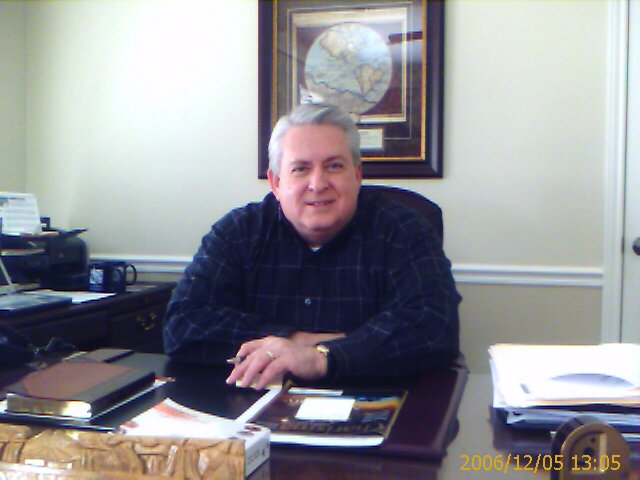
Well, one thing led to another and in a few moments we had him up and running at davidshibley.blogspot.com. David is one of the leading spokesmen for world missions in the charismatic world today, the author of several books including A Force in the Earth
 and The Missions Addiction
 . Anything he writes will be well worth reading!
If you know pastors in developing countries, in particular, I encourage you to point them toward another of Global Advance's websites entitled www.2tim2.org. It contains resources for spiritual leaders in English, Spanish, French, and Russian. At Hillcrest Church, we believe in David and the Global Advance ministry and we support them financially on an ongoing basis. If you would like to find out more about the work they do around the world, check out their online video entitled, Touching Leaders - Changing Nations.
Subscribe to:
Posts (Atom)


